Showing posts with label google. Show all posts

Privacy? We Got Over It.

Yesterday's Wall Street Journal had an interesting Op/Ed on privacy, highlighting contemporary expectations of privacy.

Information Age - WSJ.com

Privacy? We Got Over It.

August 25, 2008; Page A11

In 1988, Congress banned video stores from disclosing the titles of films that people rent. The issue arose because in the battle to block Robert Bork from the Supreme Court, someone leaked his video rentals.

Fast-forward to this summer, and a federal judge hearing a $1 billion copyright complaint by Viacom ordered YouTube to turn over online records about which computer addresses were used to watch which videos on the site. The judge dismissed privacy concerns as "speculative." How quickly our expectations of privacy have changed.

Privacy advocates objected that with access to Internet protocol addresses, it would be possible to track who watched what. Hundreds of millions of people have watched videos on YouTube since its founding in 2005 -- indeed, by one estimate, virtually everyone who uses the Web has watched a video on the site. This makes it surprising that there was such little public outcry about this potential loss of privacy. Google, which owns YouTube, has complied with the judge's order by using encryption to hide individual records, but it is indeed "speculative" how much people would object to disclosing this online behavior.

This incident is a telling moment. We seem to be following the advice of Scott McNealy, chairman of Sun Microsystems, who in 1999 said, "You have zero privacy anyway. Get over it." And the observation by Oracle CEO Larry Ellison: "The privacy you're concerned about is largely an illusion. All you have to give up is your illusions, not any of your privacy."

These comments could be dismissed as technology executives trying to minimize complaints about technology. But whatever we say about how much we value privacy, a close look at our actual behavior suggests we have gotten over it. A recent study by AOL of privacy in Britain found that 84% of people said they would not disclose details about their income online, but in fact 89% of them willingly did.

Amazon closely records our taste in books, Gmail scans our emails to deliver relevant ads, and electronic tolls track where we drive. Profiles on MySpace and Facebook are accessible, forever. The disclosure that Judge Bork liked to rent British comedies seems quaint in comparison.

Records about us are no longer kept in scattered manila files in dusty cabinets, but digitally, which means in permanent records that can be combined with other records to paint a full picture of our tastes and habits. Information held by different retailers, insurers and government agencies can be mined to create constantly updated files more complete than the most tenacious intelligence report on a suspected criminal a generation ago.

Privacy advocates do their jobs by reminding us of these risks, but our choices all seem to be in the direction of trading away privacy. The fantastic power and convenience of digital life has led us to change what we consider private in ways that we can only begin to understand.

Indeed, our expectations of privacy have changed radically over time. Stanford law professor Lawrence Friedman in his recent book, "Guarding Life's Dark Secrets," documents the total lack of privacy expectations through the medieval period, when people lived together with no option for privacy, to a period of privacy for some people and some purposes as part of what he calls the "Victorian compromise." Propriety was defined through social norms focused on reputation, which included significant freedom for otherwise scandalous behavior if it was done carefully, in private.

"If the nineteenth century was a world of privacy and prudery, a world of closed doors and drawn blinds," Mr. Friedman writes, "then the world of the twenty-first century is the world of the one-way mirror, the world of the all-seeing eye."

We now seem happy to trust companies with our information for benefits such as one-click buying and online searches for personally relevant results. In a digital world where it is possible to know more than ever about everything, including one another, the new vice may be the flip side of privacy -- concealing information about ourselves of legitimate value to others.

In the physical world, surveillance cameras, satellites and bio-recognition systems have redefined privacy expectations. We have learned that "privacy can be very dangerous," as federal appeals judge Richard Posner has observed. "Obviously if you're a terrorist, privacy is enormously important. So the more we think of privacy as endangering us, that will reinforce these commercial incentives to surrender privacy."

Privacy remains a virtue, or at least we still say it does. But the balance has been tipped by other values, such as transparency, a free flow of information and physical security. We're in the early stages of adapting to more digital and visible lives, with privacy expectations better defined by what we do than by what we say.

Google moves to have lawsuit thrown out, arguing complete privacy does not exist

In the "Street View" lawsuit with the Borings (see: Boring lawsuit over Google's "Street View"), Google has filed a motion to have the suit dismissed. Google argues that in the 21st century, complete privacy does not exist. The Smoking Gun has Google's motion here: Google: "Complete Privacy Does Not Exist" - July 30, 2008

Google and Viacom agree to protect user privacy

When the order was made that Google provide Viacom with its raw user logs (a move which significantly compromised user privacy), I wrote that the court could have ordered that the information be anonymised. (Canadian Privacy Law Blog: Commentary on the YouTube / Viacom order)

I don't think I can take any credit for this next move, but I'm sure the loud outcry has had an influence: Google and Viacom have agreed to anonymise the data using a one-way function so that the actual IP addresses cannot be reverse-engineered and Viacom has agreed to not even try. The stipulation filed with the court is here. Extract:

IT IS HEREBY STIPULATED AND AGREED, by and between the undersigned
counsel of record:

1. Substituted Values: When producing data from the Logging Database
pursuant to the Order, Defendants shall substitute values while preserving uniqueness for
entries in the following fields: User ID, IP Address and Visitor ID. The parties shall
agree as promptly as feasible on a specific protocol to govern this substitution whereby
each unique value contained in these fields shall be assigned a correlative unique
substituted value, and preexisting interdependencies shall be retained in the version of the
data produced. Defendants shall promptly (no later than 7 business days after execution
of this Stipulation) provide a proposed protocol for this substitution. Defendants agree to
reasonably consult with Plaintiffs’ consultant if necessary to reach agreement on the
protocol.

2. Non-Circumvention: The parties agree that they shall not engage in any
efforts to circumvent the encryption utilized pursuant to Paragraph 1 this Stipulation.
This Paragraph does not limit in any way any party’s rights under Paragraph 8 below.


For background, see all posts tagged: Viacom v Google. Also, the Ontario Privacy Commissioner applauds this move: CNW Group | OFFICE OF THE INFORMATION AND PRIVACY COMMISSIONER/ONTARIO | Commissioner Cavoukian Applauds Agreement Protecting YouTube Users' Privacy

Privacy protections disappear with a judge's order

More commentary on the Viacom v. Google/YouTube case, this time from MIT's Technology review:

Technology Review: Privacy protections disappear with a judge's order


Privacy protections disappear with a judge's order

By Associated Press

NEW YORK (AP) _ Credit card companies know what you've bought. Phone companies know whom you've called. Electronic toll services know where you've gone. Internet search companies know what you've sought.

It might be reassuring, then, that companies have largely pledged to safeguard these repositories of data about you.

But a recent federal court ruling ordering the disclosure of YouTube viewership records underscores the reality that even the most benevolent company can only do so much to guard your digital life: All their protections can vanish with one stroke of a judge's pen.

"Companies have a tremendous amount of very sensitive data on their customers, and while a company itself may treat that responsibly ... if the court orders it be turned over, there's not a lot that the company that holds the data can do," said Jennifer Urban, a law professor at the University of Southern California.

In the past, court orders and subpoenas have generally been targeted at records on specific individuals. With YouTube, it's far more sweeping, covering all users regardless of whether they have anything to do with the copyright infringement that Viacom Inc., in a $1 billion lawsuit, accuses Google Inc.'s popular video-sharing site of enabling.

It's a scenario privacy activists have long warned about.

"What we're seeing is (that) the theoretical is becoming real world," said Lauren Weinstein, a veteran computer scientist. "The more data you've got, the more data that's going to be there as an attractive kind of treasure chest (for) outside parties."

U.S. District Judge Louis L. Stanton dismissed privacy arguments as speculative.

Last week, Stanton authorized full access to the YouTube logs -- which few users even realize exist -- after Viacom and other copyright holders argued that they needed the data to prove that their copyright-protected videos for such programs as Comedy Central's "The Daily Show with Jon Stewart" are more heavily watched than amateur clips.

"This decision makes it absolutely clear that everywhere we go online, we leave tracks, and every piece of information we access online leaves some sort of record," Urban said. "As consumers, we should all be aware of the fact that this sensitive information is being collected about us."

Mark Rasch, a former Justice Department official who is now with FTI Consulting Inc., said the ruling could open the floodgates for additional disclosures.

Though lawyers have known to seek such data for years, Rasch said, judges initially hesitant about authorizing their release may look to Stanton's ruling for affirmation, even though U.S. District Court rulings do not officially set precedence.

The YouTube database includes information on when each video gets played. Attached to each entry is each viewer's unique login ID and the Internet Protocol, or IP, address for that viewer's computer -- identifiers that, while seemingly anonymous, can often be traced to specific individuals, or at least their employers or hometowns.

Elsewhere, search engines such as Google and Yahoo Inc. keep more than a year of records on your search requests, from which one can learn of your diseases, fetishes and innermost thoughts. E-mail services are another source of personal records, as are electronic health repositories and Web-based word processing, spreadsheets and calendars.

One can reassemble your whereabouts based on where you've used credit cards, made cell phone calls or paid tolls or subway fares electronically. One can track your spending habits through loyalty cards that many retail chains offer in exchange for discounts.

Though companies do have legitimate reasons for keeping data -- they can help improve services or protect parties in billing disputes, for instance -- there's disagreement on how long a company truly needs the information.

The shorter the retention, the less tempting it is for lawyers to turn to the keepers of data in lawsuits, privacy activists say.

With some exceptions in banking, health care and other regulated industries, requests are routinely granted.

Service providers regularly comply with subpoenas seeking the identities of users who write negatively about specific companies, at most warning them first so they can challenge the disclosure themselves. The music and movie industries also have been aggressive about tracking individual users suspected of illegally downloading their works.

Law enforcement authorities also turn to the records to help solve crimes.

The U.S. Justice Department had previously subpoenaed the major search engines for lists of search requests made by their users as part of a case involving online pornography. Yahoo, Microsoft Corp.'s MSN and Time Warner Inc.'s AOL all complied with parts of the legal demand, but Google fought it and ultimately got the requirement narrowed.

In the YouTube case, Viacom largely got the data it wanted.

Google has said it would work with Viacom on trying to ensure anonymity, and Viacom has pledged not to use the data to identify individual users to sue. The YouTube logs will also likely be subject to a confidentiality order.

But privacy advocates warn that there's no guarantee that future litigants will be as restrained or that data released to lawyers won't inadvertently become public -- through their inclusion as an attachment in a court filing, for instance.

And retailers, government agencies and others are regularly announcing that personal information, stored without adequate safeguards, is being stolen by hackers or lost with laptops or portable storage drives.

"You just never know," said Steve Jones, an Internet expert at the University of Illinois at Chicago. "There are some circumstances under which what seems to be private information is going to be shared with a third party, and the court says it's OK to do that."

Copyright Technology Review 2008.

Judge Protects YouTube's Source Code, Throws Users To The Wolves

It is not often that a columnist for a major national newpaper calls a federal court judge a moron, but that's just what Michael Arrington on the Washtington Post website calls Judge Stanton, referring to Viacom v. Google/YouTube. See: Judge Protects YouTube's Source Code, Throws Users To The Wolves - washingtonpost.com.

Ontario Commissioner calls on Google to appeal Viacom / Youtube ruling

Hot off the presses: The Information and Privacy Commissioner of Ontario has written to Google calling for Google to appeal the recent Viacom v. Google disclosure order:

CNW Group OFFICE OF THE INFORMATION AND PRIVACY COMMISSIONER/ONTARIO Privacy Commissioner Ann Cavoukian urges Google to appeal YouTube ruling

Privacy Commissioner Ann Cavoukian urges Google to appeal YouTube ruling

TORONTO, July 10 /CNW/ - Ontario Information and Privacy Commissioner Ann
Cavoukian is urging Google to appeal the recent ruling of U.S. District Court
Judge Louis Stanton, requiring the disclosure of YouTube users' information to
Viacom. YouTube, a popular website, is owned by Google.

In a letter to Sergey Brin, Google's President of Technology, the
Commissioner emphasized her deep concerns about the privacy implications of
the ruling, which she was asked to outline earlier this week on Canada AM.

Commissioner Cavoukian said "I was astounded to learn that Google had
been ordered to disclose certain YouTube information, which includes users'
login IDs and IP addresses, for use in Viacom's copyright infringement lawsuit
against YouTube." The Commissioner felt that Judge Stanton had "failed to
consider that user login IDs and video viewing habits can reveal a great deal
of sensitive personal information."

In response to suggestions that the data be "anonymized" before its
release to Viacom's legal counsel, the Commissioner noted that it is possible
to re-identify individuals by linking their data with publicly available
personal information, such as that found in telephone directories. "Simply
stripping certain data fields from a database is not sufficient to safeguard
the privacy of individuals" warned the Commissioner.

Despite the Judge's associated protection order which attempts to limit
the authorized uses of YouTube users' information by Viacom, this does not
eliminate the Commissioner's concerns. Companies simply cannot guarantee that
information, once obtained, will not be subject to unauthorized use or
disclosure. "Witness the example of identity theft" she noted. "The majority
of instances of identity theft result from insider abuse."

"While I have sympathy for the rights of intellectual property holders,
businesses should not rely on the surveillance of consumers to protect their
copyright interests. It is not acceptable to allow copyright enforcement to
come at the expense of users' privacy."

The full text of the letter to Google may be found on the Commissioner's
website at www.ipc.on.ca in the What's New section.


Previously: Commentary on the YouTube / Viacom order, Judge orders that YouTube hand over viewer records.

Commentary on the YouTube / Viacom order

I had the chance yesterday to read the decision in Viacom International v. YouTube (previously: Canadian Privacy Law Blog: Judge orders that YouTube hand over viewer records). The request and the order are appalling from a privacy point of view, in my humble opinion.

It appears clear from the decision that Viacom, et al. were ostensibly not looking for information about users of Google Video and YouTube, but this will certainly be the side-effect. In the preliminary motion, Viacom was seeking a number of orders from the court to help it build its billion dollar case for copyright infringement against the video sites. Because the vast majority of the content is uploaded by users, Viacom is going after YouTube on the basis that they assist and encourage the violation of copyright by users and are therefore responsible financially for it. The reason put forward by Viacom for seeking the full user logs was to compare the viewership (aka hits) of allegedly pirated content against viewership of non-pirated materials. If they can show that allegedly pirated content is more popular, the reasoning goes, they can show that YouTube has a financial interest in allowing pirated content on the site.

Google attempted to argue to the Court that handing over the raw logs would be intrusive of privacy for the sites' users. Unfortunately for the users, the Court didn't put much weight in these arguments as it referred to Google's past positions that IP addresses cannot identify individuals:


Defendants argue that the data should not be disclosed
because of the users’ privacy concerns, saying that
“Plaintiffs would likely be able to determine the viewing
and video uploading habits of YouTube’s users based on the
user’s login ID and the user’s IP address” (Do Decl. ¶ 16).

But defendants cite no authority barring them from
disclosing such information in civil discovery proceedings,
and their privacy concerns are speculative. Defendants do
not refute that the “login ID is an anonymous pseudonym
that users create for themselves when they sign up with
YouTube” which without more “cannot identify specific
individuals” (Pls.’ Reply 44), and Google has elsewhere
stated:

We . . . are strong supporters of the idea that
data protection laws should apply to any data
that could identify you. The reality is though
that in most cases, an IP address without
additional information cannot.

Google Software Engineer Alma Whitten, Are IP addresses
personal?, GOOGLE PUBLIC POLICY BLOG (Feb. 22, 2008), http://googlepublicpolicy.blogspot.com/2008/02/are-ip-addresses-personal.html (Wilkens Decl. Ex. M).


So why does Viacom need the full logs? Because they need to try to determine unique viewership of the content. They need a way to distinguish one viewer from another.

Do they need full IP addresses? I don't think so. While we are talking about terabytes of data, it would be trivial to run all the logs through a software routine that would use a "one way hash" to make each IP address unique while not disclosing the IP address itself.

Why the big deal? While Viacom obtained the information for one purpose (to build its case against YouTube), it may be able to use the information for other purposes. At least in Canada, that would be covered by the implied undertaking rule that would require court permission before using it for any other purpose. But the bigger deal is the chilling effect on viewers. Casual web surfers may know that somewhere their digital footprints are being recorded, but they don't spend a lot of time thinking about it. This case should make internet users think carefully about where they are surfing, what they are viewing and the fact that once personal information is recorded and retained, it will be available for all kinds of secondary uses. Some of these secondary uses, such as litigation or criminal investigations, are beyond their control and there is no opt-out. The Viacom order includes the personal information of innocent viewers who were only viewing public domain or properly licensed content. Those logs include my IP addresses, which includes information about what I've viewed and what my kids have viewed. I'm sure that it includes your IP address too.

What to do? If you are an online service provider, don't create logs. If you create logs, don't keep them. It's that simple. (If you are about to be served with a subpoena, don't delete them. It's too late and you'll be hit with accusations of spoliation.) If you are an internet user, look into Tor.

Judge orders that YouTube hand over viewer records

This is some pretty scary stuff. Not only has Viacom (shame on Viacom) demanded that Google hand over the records of all users who viewed certain YouTube videos (yup, viewed not uploaded) but a Judge has actually ordered this. Perhaps not surprisingly, Google's argument that IP addresses are not personal information has been used against its arguments that handing over this information would be unduly intrusive of personal privacy. See: Judge Orders YouTube to Give All User Histories to Viacom Threat Level from Wired.com.

Google's Street View complies with Japan privacy law, regulator says

The Japanese Communications Ministry has concluded that Google's Street View complies with Japan's data protection laws provided it continues to blur individual faces. It appears to be a preliminary opinion as more public input is being sought over the coming months.

The Hindu News Update Service

Japan says 'Ok' to Google's Street View service

Tokyo (PTI): Japan's government has concluded that Google's popular Street View service does not violate the country's privacy laws if the search engine giant takes safeguards like blurring people's faces.

An advisory panel of the communications ministry has determined that Google's Street View service would be consistent with Japan's personal information protection law if the US-based firm takes appropriate measures such as blurring identifiable images, such as faces, ministry officials said.

The pronouncement marks the first time that the Internal Affairs and Communications Ministry has expressed an opinion on the legality of the Google service, which provides close-up, 360-degree colour views of city streets, as they were caught by Google's Street View cameras installed on vehicles.

It amounted to turning down requests by dozens of city Assemblies across Japan -- including Tokyo's Machida city Assembly and Nara Prefecture's Ikoma city Assembly -- which adopted resolutions calling on the government to place curbs on the service, Kyodo news agency reported.

The ministry will release its final conclusion possibly in August after soliciting views from citizens.

Google launched its Street View service for 12 Japanese cities in August last year.

Google execs testify about Street View and privacy

Yesterday, executives from Google Canada testified to the Parliamentary Standing Committee on Ethics, Privacy and Access to Information about their Street View product and how Google is addressing privacy concerns.

Here's some of the media coverage from the Ottawa Citizen, which I'll supplement with the actual testimony when it's posted on the Committee's site:

Google ‘Street View’ amended to allay privacy concerns, executive tells MPs


OTTAWA — Google’s controversial “Street View” feature won’t infringe on Canadians’ privacy rights, the company’s head of Canadian operations said Wednesday in advance of an appearance before a House of Commons committee.

Jonathan Lister, head of Google Canada, was to stand before a federal government committee Wednesday afternoon to defend Google’s Street View service.

Lister came to Ottawa equipped with testimonials from Street View users all over the world — including Boris Johnson, mayor of London. He also offered data that suggest Canadians might be eager to see their home country represented on the new service, as more than 100 million Street View images from other countries have been pulled up by Canadians.

“It has been extremely well received and as people use it, they find more uses for it,” said Lister. “We’re getting indications that it’s going to be popular in Canada. We’ve got testimonials and accolades from tourism officials, the mayor of London, and Australian tourism officials that support the fact that it’s been widely well received.”

Lister was being brought before the access to information, privacy and ethics committee after the committee passed a motion demanding Google explain any impact its new Street View service may have on Canadians’ privacy rights.

The feature allows someone using Google Maps or Google Earth to click on a street or a building and see a picture of the area. The cameras used to capture the picture allow onlookers to swivel 360 degrees within the image and even allows Internet users the ability to take a virtual stroll through neighbourhoods.

Google has been preparing for the roll-out of Street View in Canada since March. The Internet search giant has also been in intense discussions with the federal privacy commissioner’s office since that time, trying to negotiate a solution that would allow Google to offer Street View images from Canada to the rest of the world without contravening Canadian privacy law.

“We think the product is compliant, but we are certainly not going to launch it until we have satisfied our concerns,” said Lister. “We continue to work with the commissioner’s office. As we get closer to rolling the product out we plan on working with local law enforcement officials and stakeholder groups.”

Lister said Google has recently revamped its internal policies to cut the amount of time the company will archive Street View pictures. The move addresses one of the privacy commissioner’s biggest concerns.

“Recently we’ve revised our retention policy such that we have made a decision to only retain these images for an adequate but not-excessive period of time, after which they will be deleted,” said Lister.

Street View also automatically blurs the faces and identifying features of people or licence plates caught by Street View’s cameras and anyone who sees their picture, or a picture of their home or vehicle can ask Google to remove the image.

Lister would not define how long an “adequate” period of time will be. He also refused to commit to a date for the official launch of Street View in Canada. Vehicles having been cruising Canadian streets and suburbs in 32 cities taking pictures for the new service over the past two months.

The access to information, privacy and ethics committee is reviewing Canada’s privacy laws to determine whether they need to be updated. The committee will roll Lister’s comments into a final report on the state of Canadian privacy legislation, which is due later this year.

Google starts collecting street view data in Europe

According to Computerworld Security, Google has started collecting images of European streets for its Street View feature, but is holding off putting the data online until it has figured out the local privacy law challenges. See: Google takes Street View snaps in Paris; lawsuits could follow.

Google releases Government Requests Tool, showing info and takedown demands

Google has just announced a new "Government Requests tool", which shows graphically how many governmental requests Google and YouTube receive for either user information or to take down content. The background is explained at the Google Public Policy Blog: Greater transparency around government requests.

This can only be a good thing. Legal processes for the disclosure of user information and the removal of content are often not well understood. Any measure that increases transparency and accountability, while providing information to inform public debate, is a good thing. I would hope to see other service providers stepping up to provide this sort of information as well.

Then I'd like to see more well-informed debate on the matter.

Privacy and internet log files

Just posted on slaw.ca:

In the past two weeks, the New York Times reported that Microsoft has made a minor concession with European privacy authorities about how long it retains its log files. A committee of European privacy regulators had asked that these logs be kept for only six months. Microsoft's response? Eighteen months.Yahoo used to keep them for thirteen months and just announced it will cut retention to 90 days. Google keeps them for nine.

The privacy implictions of these innocuous log files have been underestimated, particularly when you think about the fulsome picture of your private life that companies like Google may be assembling about you. The information in an ordinary web-server log usually contains the just a tid-bit of information. One "hit" on a website may look like this (but all on one line):

127.0.0.1 - frank 
[10/Oct/2000:13:55:36 -0700]
"GET /apache_pb.gif HTTP/1.0" 200 2326
"http://www.example.com/start.html"
"Mozilla/4.08 [en] (Win98; I ;Nav)"

The first bundle of numbers is the IP address of the computer that requested a particular web-page. "Frank" refers to a userid, which is usually not eabled. The next field is the date" Following that, and usually preceded by "GET" is the command your web-browser sent to the server. The next bits are the status code returned by the server and then the size of the entity requested. Next is something called a "referer" (mis-spelled) , followed by details about your browser.

Since many people often share the same IP address (it could be one IP for an entire company or just a group of people in a house using the same internet connection), some have argued it is not personal information and a log-file doesn't contain personal information. The problem is that even if an IP address is not directly connected to one individual, one can do some easy analysis to make the connections. After AOL released supposedly de-identified search logs to researchers, an intrepid reporter was able to track down at least one of the users who had some very personal health-related searches in the logs (see: Users identifiable by AOL search data).

What's additionally troubling from a privacy point of view is that the large inernet companies, like Google, Yahoo and Microsoft, don't just have your search queries. Increasingly, they have a huge trove of data sources in their logs.

Take Google, for example. Google has their famous Google search. They also have GMail, Google Analytics, Google AdSense, Google Documents, Google Toolbar and more. Each time you "hit" one of their sites, you're in their logs. Most internet users hit Google's logs dozens of times a day and on many of those occasions aren't even aware that they're using a Google service. Google has what is probably the most popular and widely used network of online advertising: AdSense. Each time you go to a website that features Google's ads, your computer sends a request to Google's servers and that "hit" goes into their logs, along with the information about what site you were visiting, when you visited and what ad was served. If you click on the ad, even more information is collected and logged. But even if you don't visit a site with Google's ads, there's a very good chance that the webmaster is using Google Analytics to find out about useage of his or her site. (Full disclosure: I use Google Analytics for my site at www.privacylawyer.ca.) I should also note that Yahoo! and MSN also have advertising networks, which collect the same sort of information.What this means is that Google, Yahoo and Microsoft register in their logs a significant portion of your usage of the internet.

And if you have a Google, Yahoo! or MSN account, that hit can be connected to your account details, includig your name.

I don't think it's too far fetched to think of a day when it will become standard for all investigations involving the internet to inlcude a warrant served on Google or Yahoo! or Microsoft for all logs related to a particular user or IP address or both.

Next week, I'll discuss efforts being made by governments and law enforcement to make log rentention mandatory.

Intel, Google Asked to Help Revise EU Data Protection Laws

This is interesting ...

Intel, Google Asked to Help Revise EU Data Protection Laws (PC World) by PC World: Yahoo! Tech

Intel, Google Asked to Help Revise EU Data Protection Laws (PC World)

Posted on Fri Dec 5, 2008 6:55PM EST

- The European Commission has set up an advisory panel including executives from Google and Intel to help it revise European Union laws on data protection.

"The aim of the group is to identify issues and challenges raised by new technologies. We are not reviewing the main data protection laws at present, but this could be a first step," said European Commission spokesman Michele Cercone.

He added that the executives were chosen in a private capacity, rather than as representatives of their companies.

Peter Fleischer, Google global privacy counsel, along with David Hoffman, Intel's group counsel for eBusiness and privacy will sit alongside data protection lawyers and regulators on the panel, which held its inaugural meeting Thursday.

"I am delighted to have been asked," Fleischer told journalists.

Many aspects of the existing E.U. legislation have been made obsolete by advances in technology, Fleischer said, referring to the E.U.'s cornerstone law, the 1995 data protection directive.

He will urge the Commission to adopt a system where companies only have to deal with one national data protection authority, instead of having to meet the demands of all 27, as they do at present.

"There is a need for harmonization of data protection enforcement in Europe," he said, adding that a system of mutual recognition among national authorities will go a long way in achieving that aim.

He also will try to persuade the Commission to move away from a location-based approach. "It worked when data was stored on paper, but with the Internet that concept is obsolete because data travels around the world and is commonly stored in many different locations at once. There is a strong need for data protection laws to take the new technology into consideration," Fleischer said.

He pointed to Canada's approach, which is not location-based, but calls on data controllers, such as companies, to be responsible for data safety.

Finally, he wants data protection laws to apply to public institutions as well as to private companies, pointing out that some of the most serious threats' to potential threats to people's data and their privacy are posed by governments, not corporations. The 1995 law only applies to the private sector.

Privacy campaign groups are critical of Google's own approach to privacy. However, none were available to comment.

Google Street View's privacy enhancing technology?


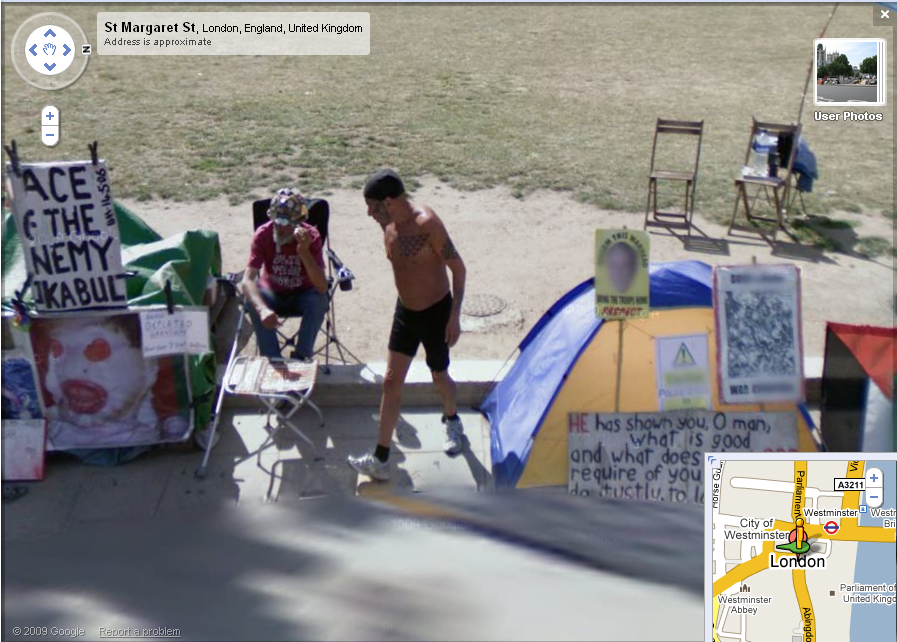
With Google's recent launch of Street View in Europe and imminent photographing of Canadian cities, I thought I'd do some quick looking around at how effective their "face blurring" technology may be. It only took one minute of wandering around London and I was able to see where it might fall off the rails.

In this particular image, the anti-war protesters are recognizable but - THANKFULLY - the image of what's probably George W. Bush has been blurred out. But not blurred to the point of non-recognition.

Google: You've come a long way, baby, but there's work to be done.

Google forced to black out hundreds of UK Street View photos after privacy protests

Google Street View went live in the UK last week. Despite the prevalence of surveillance in Britain, complaints have rolled in and Google has taken down hundreds of pictures. See: Google forced to black out hundreds of Street View photos after privacy protests - but site gets record hits Mail Online.

Google wins Street View privacy suit

I blogged a while ago about a lawsuit brought against Google by the Boring family, alleging that Google's Street View was an invasion of their privacy by showing images of the Borings' house. (Google moves to have lawsuit thrown out, arguing complete privacy does not exist , Boring lawsuit over Google's "Street View" ).

According to CNET, the case has been thrown out by the Federal Court (here's the decision).

Via: Google wins Street View privacy suit Digital Media - CNET News.

For more on this topic generally, see postings tagged with "google street view".

Take Pittsburgh off Google Street View. Think of the children!

This blog is familiar with previous privacy issues raised by Google's street view (see: posts tagged "google street view"), but this seems a little over the top. A group is calling for the removal of Pittsburgh from Google street view because predators could use it to locate schools, playgrounds and other places where children might congregate. Hmm. I guess there's no other way of getting that information.

See: Children's safety group wants city off of Google's Street View

Telling community stories with Street View

Here's a nice departure from the usual privacy complaining about Google's Street View. The concept is simple: turn Google Street View into a community event. Its execution was perfect.

I'll let the authors describe it:

STREET WITH A VIEW: a project by Robin Hewlett & Ben Kinsley

Street With A View introduces fiction, both subtle and spectacular, into the doppelganger world of Google Street View.

On May 3rd 2008, artists Robin Hewlett and Ben Kinsley invited the Google Inc. Street View team and residents of Pittsburgh’s Northside to collaborate on a series of tableaux along Sampsonia Way. Neighbors, and other participants from around the city, staged scenes ranging from a parade and a marathon, to a garage band practice, a seventeenth century sword fight, a heroic rescue and much more...

Street View technicians captured 360-degree photographs of the street with the scenes in action and integrated the images into the Street View mapping platform. This first-ever artistic intervention in Google Street View made its debut on the web in November of 2008.

An incredible cast of real-life characters contributed their time, energy and talents to creating pseudo-street life on Sampsonia Way. Please check out the scene breakdown, the participant page and the video documentation to learn more about the artists, groups and participants that made Street With A View possible.


Bravo!

Google reduces log retention times

Google has just announced that they are cutting their log retention period in half: from 18 monts to 9 months.

From the Official Google Blog:

Official Google Blog: Another step to protect user privacy

Today, we're announcing a new logs retention policy: we'll anonymize IP addresses on our server logs after 9 months. We're significantly shortening our previous 18-month retention policy to address regulatory concerns and to take another step to improve privacy for our users.

Back in March 2007, Google became the first leading search engine to announce a policy to anonymize our search server logs in the interests of privacy. And many others in the industry quickly followed our lead. Although that was good for privacy, it was a difficult decision because the routine server log data we collect has always been a critical ingredient of innovation. We have published a series of blog posts explaining how we use logs data for the benefit of our users: to make improvements to search quality, improve security, fight fraud and reduce spam.

Over the last two years, policymakers and regulators -- especially in Europe and the U.S. -- have continued to ask us (and others in the industry) to explain and justify this shortened logs retention policy. We responded by open letter to explain how we were trying to strike the right balance between sometimes conflicting factors like privacy, security, and innovation. Some in the community of EU data protection regulators continued to be skeptical of the legitimacy of logs retention and demanded detailed justifications for this retention. Many of these privacy leaders also highlighted the risks of litigants using court-ordered discovery to gain access to logs, as in the recent Viacom suit.

Today, we are filing this response (PDF file) to the EU privacy regulators. Since we announced our original logs anonymization policy, we have had literally hundreds of discussions with data protection officials, government leaders and privacy advocates around the world to explain our privacy practices and to work together to develop ways to improve privacy. When we began anonymizing after 18 months, we knew it meant sacrifices in future innovations in all of these areas. We believed further reducing the period before anonymizing would degrade the utility of the data too much and outweigh the incremental privacy benefit for users.

We didn't stop working on this computer science problem, though. The problem is difficult to solve because the characteristics of the data that make it useful to prevent fraud, for example, are the very characteristics that also introduce some privacy risk. After months of work our engineers developed methods for preserving more of the data's utility while also anonymizing IP addresses sooner. We haven't sorted out all of the implementation details, and we may not be able to use precisely the same methods for anonymizing as we do after 18 months, but we are committed to making it work.

While we're glad that this will bring some additional improvement in privacy, we're also concerned about the potential loss of security, quality, and innovation that may result from having less data. As the period prior to anonymization gets shorter, the added privacy benefits are less significant and the utility lost from the data grows. So, it's difficult to find the perfect equilibrium between privacy on the one hand, and other factors, such as innovation and security, on the other. Technology will certainly evolve, and we will always be working on ways to improve privacy for our users, seeking new innovations, and also finding the right balance between the benefits of data and advancement of privacy.

Popular entries


Web world of law online google © 2012